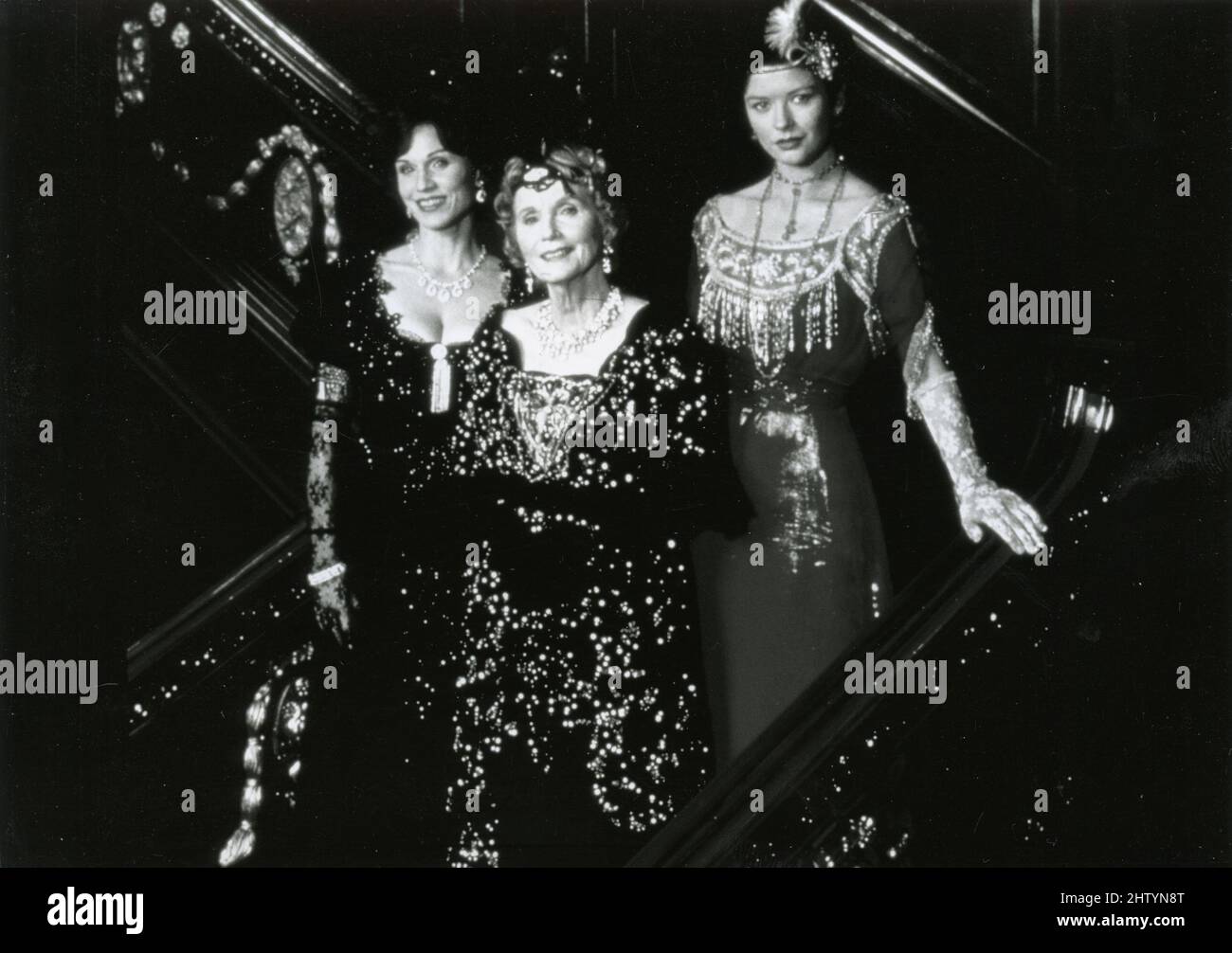
Most people think James Cameron’s 1997 epic was the only time we revisited the "unsinkable" ship in the nineties. They're wrong. A full year before Leo and Kate stood on that prow, CBS aired a two-part miniseries simply titled Titanic. It was a massive gamble. It had a huge budget for TV standards—about $13 million—and it featured a pre-superstardom Catherine Zeta-Jones.
If you haven't seen it lately, the Titanic 1996 Catherine Zeta Jones version is a wild ride. It’s gritty. It’s kinda soapy. Honestly, it feels way more like a Victorian melodrama than a high-tech disaster flick. While Cameron went for sweeping romanticism and technical perfection, director Robert Lieberman leaned into the scandal and the class warfare of the era.
It’s weirdly fascinating to look back on now. Before she was an Oscar winner or the face of The Legend of Zorro, Zeta-Jones was Isabella Paradine, a woman caught between a stale marriage and a former flame on a doomed luxury liner.
The Isabella Paradine Factor: Catherine Zeta-Jones Before the A-List
Let’s talk about Isabella. In the Titanic 1996 Catherine Zeta Jones miniseries, her character isn't a historical figure. She’s a fictional creation meant to bridge the gap between the upper-crust opulence and the messy reality of human desire. Zeta-Jones plays her with this sort of smoldering, restrained intensity that makes you realize why Hollywood was about to lose its mind over her.
Isabella is traveling with her husband and daughter, but she runs into Wynn Park, played by Peter Gallagher. Yes, Sandy Cohen from The O.C. is in this. They have a history. They have chemistry. The whole subplot feels like it belongs in a Harlequin novel, but in the context of a sinking ship, it actually adds a layer of "carpe diem" desperation that works.
She wasn't just "the girl" in this movie. She was the emotional anchor. While the script has some clunky moments—TV writing in 1996 wasn't exactly Succession—Zeta-Jones elevates the material. You can see the movie star quality in every frame. It’s also worth noting that Steven Spielberg reportedly saw her in this miniseries and was so impressed that he recommended her for The Mask of Zorro. So, without this TV movie, her entire career might have looked totally different.
A Darker, Meaner Version of History
The 1996 version doesn't hold back on the ugliness. One of the most controversial aspects of this production is how it handles the character of Simon Doonan, a fictional thief played by Tim Curry.
Wait. Tim Curry is in this? Yes. And he is terrifying.
Unlike the 1997 film, where the "villain" is basically a jealous fiancé with a gun, the 1996 miniseries features a subplot involving sexual assault and cold-blooded robbery in the lower decks. It’s dark. It’s uncomfortable. It reminds you that the Titanic wasn't just a place for star-crossed lovers; it was a floating city filled with some truly terrible people.
Historical Figures and Creative Liberties
You've got the standard players here too. George C. Scott—the legend himself—plays Captain Smith. He brings a certain gravitas, though he plays Smith more as a tired man nearing the end of his rope than the noble hero we sometimes see. Then there's Eva Marie Saint as Hazel Foley.
The production takes some massive liberties. For example:
- It suggests the ship was actually speeding to try and beat a record, which is a common myth but largely debunked by modern historians like Tim Maltin.
- The portrayal of the Californian (the ship that didn't come to the rescue) is particularly biting here.
- The sinking sequence is... well, it’s 1990s TV CGI. It’s rough.
But there’s a charm to the practical sets. They filmed a lot of this in Vancouver, and you can feel the physical space of the corridors. It doesn't have the "infinite" feel of Cameron's digital water, but it feels claustrophobic in a way that actually aids the tension.
Why the 1996 Miniseries Still Matters
You might wonder why anyone should care about a thirty-year-old TV movie. It's because the Titanic 1996 Catherine Zeta Jones production represents the last gasp of the "Big Event" network miniseries. This was back when families would actually sit down on a Tuesday night to watch Part 2 of a televised event.
It also serves as a fascinating comparison point for how we tell stories about tragedy. Cameron’s film is a technical marvel, but it’s very polished. The 1996 version is messy. It deals with the "Third Class" experience in a way that feels more visceral, even if it's occasionally exploitative.
The relationship between Isabella and Wynn provides a different perspective on the "lost love" trope. They aren't teenagers. They are adults with lives, regrets, and complicated baggage. Watching Zeta-Jones navigate that while the world literally falls apart around her is a masterclass in early-career acting.
Production Facts and Trivia
If you're a Titanic nerd, you'll notice some specific details in the 1996 version that are actually quite accurate. The interiors of the First Class smoking room were quite well-researched for the time.
However, the budget constraints are obvious. The ship often looks like it has about fifty passengers total. The "crowd" scenes during the sinking feel thin compared to the thousands of extras used a year later. But again, for a TV budget in the mid-90s, it was an ambitious undertaking.
- Director: Robert Lieberman
- Original Air Date: November 17 & 19, 1996
- Network: CBS
- Key Cast: Catherine Zeta-Jones, Peter Gallagher, George C. Scott, Tim Curry, Eva Marie Saint
The score by Lennie Niehaus is also surprisingly good. It’s moody and somber, avoiding the pop-ballad trappings that would eventually define the '97 film's legacy. It lets the tragedy speak for itself.
How to Watch and What to Look For
Finding a high-quality version of the Titanic 1996 Catherine Zeta Jones miniseries can be a bit of a hunt. It was released on DVD years ago, and occasionally pops up on streaming services like Amazon Prime or Plex. If you do find it, watch it with an open mind.
Don't compare the special effects to modern standards. Instead, look at the performances. Look at how Zeta-Jones commands the screen. Observe the way the story tries to juggle four or five different plotlines at once—the wireless operators, the thieves, the star-crossed lovers, and the grieving mother. It’s an ensemble piece in the truest sense.
Actionable Takeaways for Film Buffs
If you’re planning a rewatch or seeing it for the first time, keep these things in mind:
- Spot the Breakout: Watch Zeta-Jones specifically for the "Star Power" moments. You can literally see the moment she outgrows television.
- Compare the "Californian" Plot: Notice how much screen time is given to the SS Californian. It’s a major historical "what if" that Cameron mostly ignored, but this version leans into the frustration of the nearby ship that did nothing.
- Appreciate the Darker Tones: Pay attention to Tim Curry’s subplot. It’s a reminder that historical tragedies were often compounded by human malice, not just icebergs.
- Check the Wardrobe: The costume design for Zeta-Jones is actually quite stunning and historically evocative of the 1912 transition into more modern silhouettes.
The Titanic 1996 Catherine Zeta Jones miniseries isn't a replacement for the 1997 film, nor is it a masterpiece of historical accuracy. It’s a snapshot of a specific moment in television history—a bold, soap-operatic, and surprisingly dark retelling of a night that continues to haunt our collective imagination. It’s worth a watch, if only to see a future queen of Hollywood find her footing on a sinking deck.
To truly appreciate this version, compare the pacing of the first hour with the second. The buildup is slow, almost like a stage play, before the chaos of the final act takes over. It’s a different kind of storytelling that values dialogue over spectacle, a rarity for the disaster genre today. Keep an eye out for the smaller character beats—they’re where the real heart of this version lives.