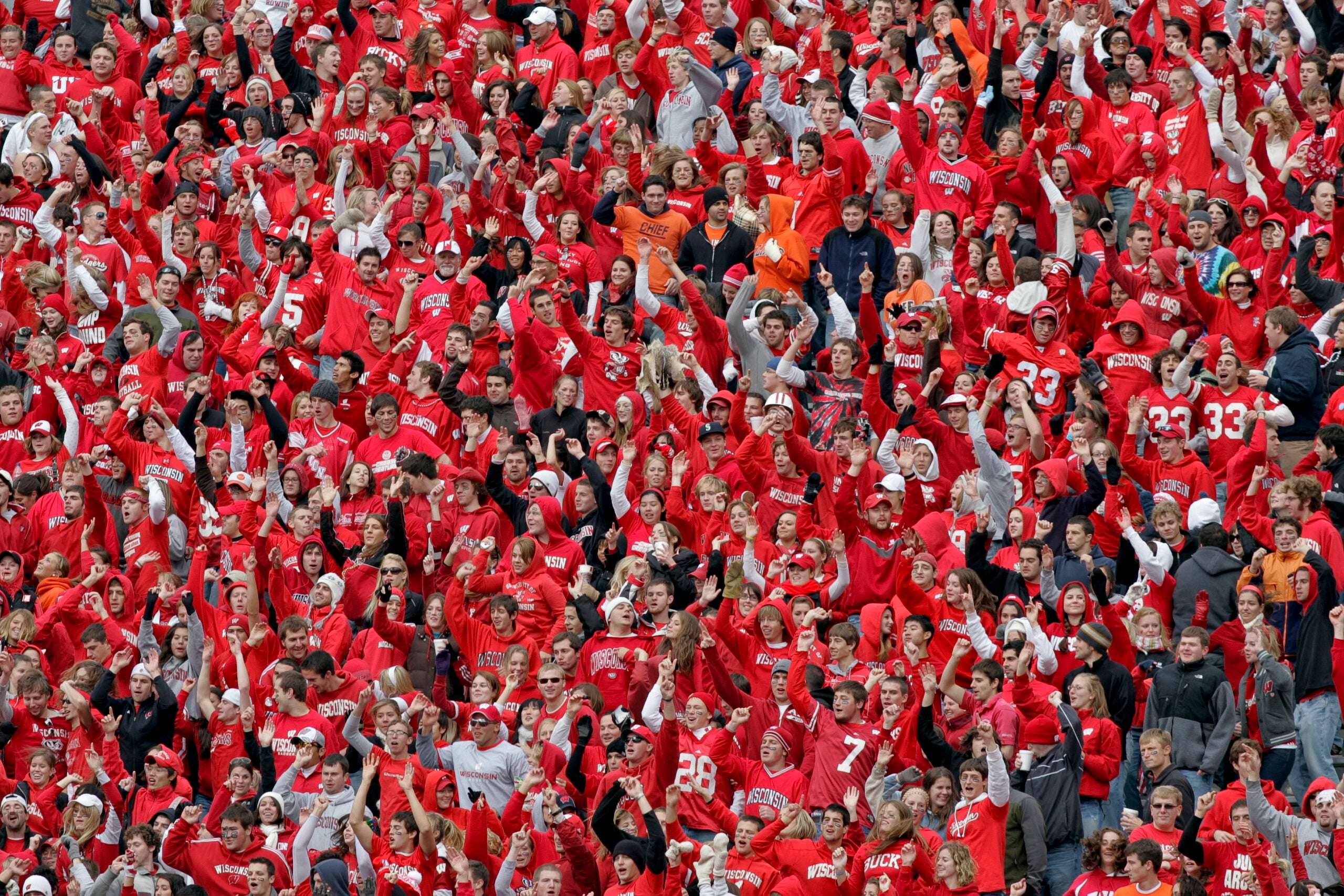
You’re standing there. Camp Randall Stadium is literally swaying. If you haven't felt the concrete beneath your feet start to ripple like a wave, it’s hard to describe the sheer anxiety and exhilaration that hits when the third quarter ends in Madison. This isn't just some crowd getting hyped. It is the University of Wisconsin Jump Around, a tradition so intense it once got banned because people thought the stadium might actually collapse.
It’s loud. It’s chaotic. It’s uniquely Madison.
Most people see the highlights on ESPN and think it’s just 80,000 people hopping in unison. But there is a weird, documented history behind why a 1992 hip-hop track by House of Pain became the unofficial anthem of a Big Ten powerhouse. Honestly, it shouldn't have worked. The song was six years old when it started, and the "Jump Around" wasn't even a planned marketing stunt. It was a fluke.
The Day the Earth (Literally) Shook in Madison
October 10, 1998. That’s the date everything changed.
The Badgers were playing Purdue. Drew Brees—yeah, that Drew Brees—was the quarterback for the Boilermakers. It was a scoreless third quarter, and the energy in the stadium felt stagnant. Erik Helland, the football team's then-conditioning coach, wanted something to wake up the players. Ryan Sondrup, a Buckeyes-turned-Badgers tight end who worked in the marketing department as an intern, suggested the House of Pain track.
When those horns hit? The student section didn't just stand up. They lost their minds.
The structural engineers at the University of Wisconsin-Madison weren't exactly thrilled, though. See, Camp Randall is old. Part of it sits on the site of a Civil War training camp. When 80,000 people jump at the exact frequency of the stadium's natural resonance, physics happens. The upper decks began to vibrate. People reported feeling nauseous from the swaying.
For a brief, dark period in 2003, the university tried to kill it.
During a renovation project, officials were worried about the structural integrity of the newly added sections. They stopped playing the song. The backlash was immediate and vitriolic. Students protested. Alumni sent angry letters. Eventually, the school brought in a team of structural engineers who basically concluded that while the swaying was terrifying, the stadium was built to flex. It’s better to bend than to break.
The University of Wisconsin Jump Around was back, and it was officially sanctioned by science.
Why a 90s Hip-Hop Song Defined a Midwestern School
It’s kind of strange when you think about it. Madison is a town known for cheese curds, beer, and cold winters. House of Pain is a group from Los Angeles with Irish-American roots. There is zero logical connection between the two.
But that’s the beauty of college football traditions. They aren't manufactured in a boardroom by a branding agency. They happen because a specific group of kids in a specific moment felt a vibe.
The Psychology of the Jump
There’s a communal aspect to it that goes beyond the music.
- The Anticipation: The "Badger Bash" atmosphere peaks right as the clock hits zero in the third.
- The Release: After an hour of grueling Big Ten defense, everyone needs to move.
- The Intimidation: Imagine being an opposing kicker trying to focus while the entire earth is vibrating.
It’s a nightmare for visiting teams. Former Ohio State players have gone on record saying they’ve never felt anything like it. It’s not just the noise; it’s the physical sensation of the ground disappearing under your cleats.
The Physics of the Sway: Is Camp Randall Safe?
Let's get nerdy for a second. Every building has a "natural frequency." If you force a building to move at that frequency, the vibrations amplify. This is called resonance.
In the early 2000s, there were genuine concerns that the "Jump Around" would lead to a catastrophic failure. The University of Wisconsin-Madison actually commissioned a study to look into this. They found that the vibrations were well within the safety limits of the steel and concrete, even if the "felt" motion was intense. Basically, the stadium acts like a giant spring.
If it didn't sway, it would crack.
Moments That Defined the Tradition
While it happens every home game, some "Jump Arounds" hit different.
The 2011 night game against Nebraska stands out. It was Nebraska’s first game in the Big Ten. The hype was astronomical. When the song started, the television cameras were shaking so hard the broadcast looked like it was filmed during an earthquake. Russell Wilson was under center back then, and the momentum from that third-quarter break carried the Badgers to a blowout win.
Then there was the 2017 game against Michigan. The snow was falling, the lights were bright, and the contrast of the red jerseys against the white ground made the entire stadium look like a shaking snow globe.
It’s those moments where the University of Wisconsin Jump Around transcends being a "song" and becomes a psychological weapon.
Debunking the Myths
People say a lot of things about this tradition that aren't quite true.
First off, it isn't the only stadium where people jump. Virginia Tech has "Enter Sandman," which registers on seismographs. But "Jump Around" is different because it involves the entire stadium, not just a student section.
Another myth: the school pays massive royalties every time they play it. While there are licensing fees (as with any music played in a stadium), it’s a standard blanket license through ASCAP/BMI. Everlast and the rest of House of Pain have actually visited Madison and expressed how much they love that their song has found a second life as a collegiate anthem.
The Rules of Jumping (For the Uninitiated)
If you’re going to a game at Camp Randall, don’t be the person sitting down. You’ll get weird looks.
- Wait for the horn. There is a distinct "da-da-da-DAAA" that kicks everything off.
- Hold onto your belongings. Phones fly out of pockets. Glasses get crushed. Secure your gear before the bass drops.
- Don't fight the sway. If you feel the concrete moving, go with it. Fighting the motion is what makes people feel sick.
- Stay for the fifth quarter. The University of Wisconsin Jump Around is the peak, but the UW Marching Band's "Fifth Quarter" is the soul of the experience.
The Cultural Impact Beyond the Field
The University of Wisconsin Jump Around has leaked into the fabric of the city itself. You’ll see "Jump Around" t-shirts in every shop on State Street. It’s played at weddings, bar mitzvahs, and local bars every Saturday.
It’s a rite of passage for students. Graduation ceremonies often feature a "Jump Around" moment. It has become shorthand for "Wisconsin Spirit."
Critics sometimes say it’s getting old. They argue that a song from 1992 doesn't resonate with 18-year-old recruits who weren't even born when it was a hit. But those critics are usually wrong. The recruits love it. The energy is infectious. It’s one of the few things that can bridge the gap between a 70-year-old donor in the suites and a freshman in the front row of the student section.
How to Experience it Right
If you want the full University of Wisconsin Jump Around experience, you have to be in the student section. Sections J through P are the epicenter. This is where the density is highest and the jumping is most rhythmic.
If you’re in the upper deck, prepare for the "sea-legs" feeling. It’s a bit like being on a boat in choppy water.
Actionable Insights for Your Visit
If you are planning a trip to Madison to witness the University of Wisconsin Jump Around, keep these logistics in mind to ensure you don't miss the moment.
- Timing is everything: The jump happens exactly between the 3rd and 4th quarters. If you leave to get a bratwurst or use the restroom with two minutes left in the 3rd, you will miss the entire thing. The song only lasts about two minutes.
- Check the Seismograph: Local news stations and the University's geology department often set up sensors during big games. After the game, you can usually find the "magnitude" of the jump online. It's a fun way to see how your specific game compared to historical records.
- Respect the "Varsity" Tradition: Immediately following the game, the crowd sings "Varsity" while swaying with arms linked. It’s the somber, emotional counterpart to the chaos of the Jump Around. Doing both gives you the full spectrum of Badger culture.
- Hydrate Early: The physical exertion of jumping for two minutes straight after three hours of cheering (and perhaps a few pre-game refreshments) is no joke.
The University of Wisconsin Jump Around isn't just a gimmick. It is a physical manifestation of a community's collective energy. It’s the sound of 80,000 heartbeats syncing up for two minutes of pure, unadulterated joy. Whether you’re an alum or just a fan of the game, standing in that stadium when the beat drops is something that stays with you. It’s proof that sometimes, the best traditions are the ones nobody saw coming.