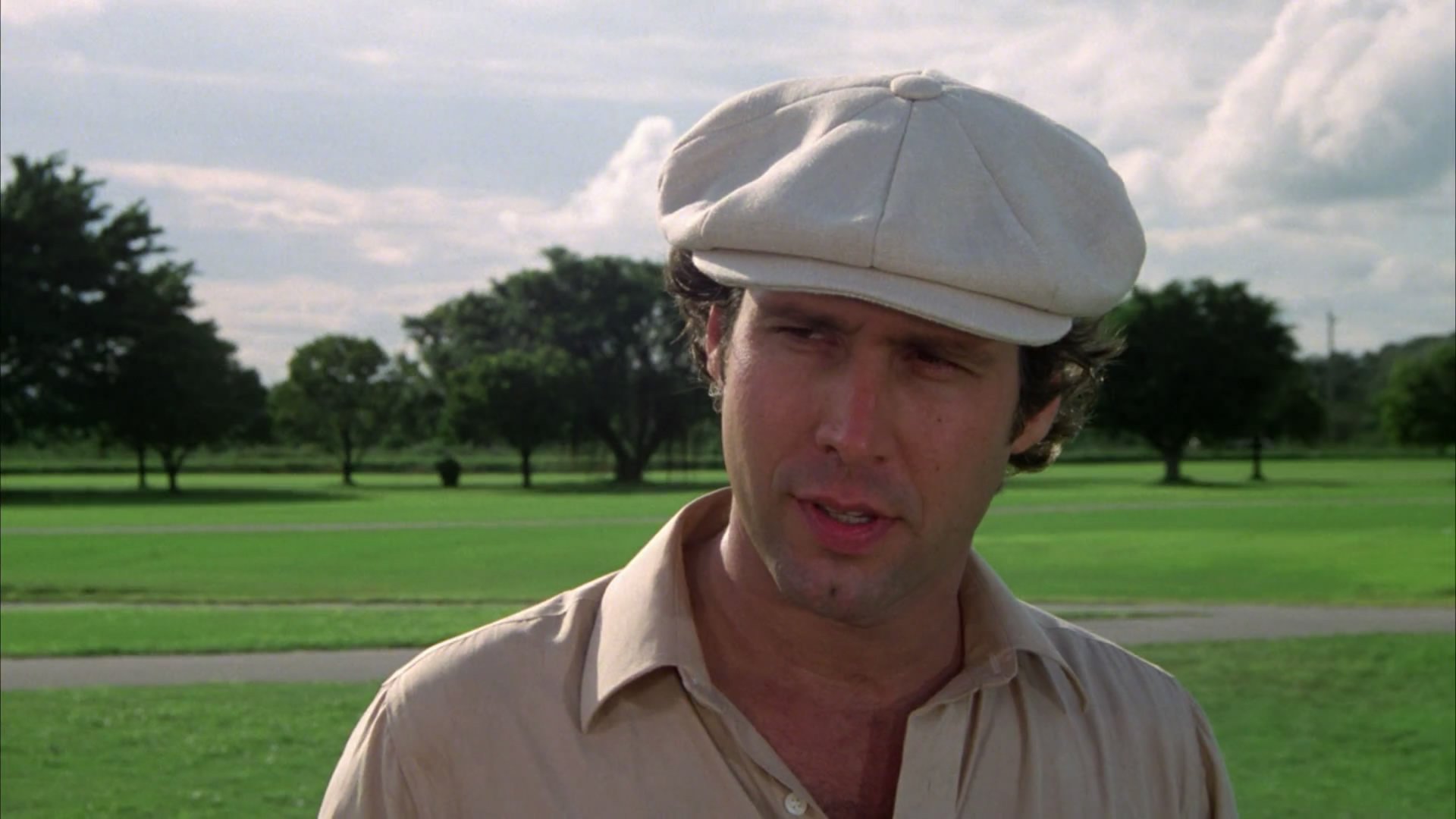
He’s basically a ghost who happens to own a lot of plaid. When we talk about Chevy Chase in Caddyshack, we aren’t just talking about a performance. We’re talking about a guy who was, at that specific moment in 1980, the funniest person on the planet. He didn't even have to try. Honestly, that’s the secret.
Ty Webb is the heart of the movie.
While Bill Murray was off fighting a puppet gopher and Rodney Dangerfield was busy being a human foghorn of one-liners, Chevy was doing something different. He was playing a zen-master billionaire who somehow forgot he was rich. It’s a weird role. Most actors would have played Ty Webb as a jerk. Not Chevy. He played him as a man who had transcended the need for a scorecard.
The Zen of Ty Webb
"Be the ball."
Everyone knows that line. It’s the ultimate Chevy Chase Caddyshack moment. But look at the scene again. He’s putting in the dark. He’s making clicking noises with his mouth. It’s totally absurd, yet he treats it with the gravity of a heart surgeon. That’s the "Chase Magic" people miss. He wasn't playing a character; he was playing a vibe.
The production of Caddyshack was famously a mess. Director Harold Ramis had never directed a feature film before. The script was more of a suggestion than a rulebook. Drugs were everywhere. Producers were panicking. Amidst that chaos, Chevy Chase showed up and decided to be the coolest guy in the room. He leaned into the improvisation.
A lot of his best stuff wasn't on the page. The scene where he pours water into the guy's bag? Pure Chevy. The weird "nanananana" putting sound? Totally him. He brought this Saturday Night Live energy to a sports movie and accidentally created a blueprint for every slacker-hero character that followed in the 90s and 2000s.
That One Scene With Bill Murray
There is only one scene where Chevy Chase and Bill Murray appear together in the whole movie. Just one. It happens in Carl Spackler’s basement (the "shed").
The history here is legendary. They didn't like each other. Not even a little bit. A few years earlier, they had a literal fistfight backstage at SNL right before Chevy went on to host. John Belushi was supposedly the one who broke it up. So, when it came time to film Caddyshack, the tension was thick.
Ramis realized he had these two comedy titans and zero scenes with them together. He grabbed them, threw them in the shed, and told them to riff.
The result? Pure gold.
They talk about "cannonballing" into the water and "achieving total consciousness" on their deathbeds. It’s two different styles of comedy clashing. Murray is grounded, grimy, and manic. Chase is detached, tall, and elegant. It works because they are trying to out-weird each other. If you watch closely, you can see the begrudging respect. Or maybe just the desire to get the scene over with. Either way, it’s the peak of the film.
Why the Chevy Chase Caddyshack Performance Almost Didn't Work
Critics hated it.
When the movie came out in July 1980, the reviews were brutal. The New York Times basically called it a series of loosely connected sketches. They weren't wrong. But they missed why people loved it. The audience didn't care about the plot involving Danny Noonan’s scholarship. They cared about Ty Webb’s bizarre philosophy on life.
Chase was at a weird crossroads in his career. He had left SNL early to become a movie star, but his first few films were... fine. Foul Play was a hit, but it was a rom-com. Caddyshack allowed him to be the "wise-ass" again. It reminded everyone why he was the original anchor of Weekend Update.
The Style of a 1980s Icon
Let’s talk about the clothes.
Chevy Chase in Caddyshack defined a very specific "country club cool" that people still try to mimic. The visor. The polo shirts. The nonchalant way he carries a golf club like it’s a walking stick. He looked like he belonged at Bushwood, which made his total disrespect for the club's rules even funnier. He was the insider who acted like an outsider.
He makes golf look effortless, which is the ultimate lie. Anyone who has swung a club knows it’s a game of frustration. Ty Webb represents the fantasy: what if you were just naturally good at everything and didn't care about any of it?
The Misconception of the "Lead"
Is Chevy Chase the lead of Caddyshack?
Technically, Michael O'Keefe (Danny Noonan) is the protagonist. He has the arc. He has the conflict. But nobody goes to a screening of Caddyshack to see Danny. They go to see the "Big Three."
- Rodney Dangerfield (The Disruptor)
- Bill Murray (The Chaos)
- Chevy Chase (The Cool)
If you remove Chevy, the movie loses its balance. Rodney is too loud. Bill is too weird. Chevy provides the middle ground. He’s the guy the audience wants to be. He gets the girl (Lacey Underall), he has the money, and he has the best lines.
Real World Context: The 2026 Perspective
Looking back from 2026, it’s easy to see how much of modern comedy owes a debt to this performance. Every "cool guy" character in a Will Ferrell or Vince Vaughn movie has a little bit of Ty Webb in their DNA. It’s that specific brand of irony.
However, we also have to acknowledge the context. Chevy’s reputation in Hollywood eventually became... complicated. Stories of him being difficult on sets like Community have colored how people view his early work. But in 1980? He was untouchable. There’s a lightness in his performance here that he rarely captured again.
What You Can Learn from Ty Webb
It’s not just about golf. It’s a philosophy.
If you’re looking to channel that Chevy Chase Caddyshack energy into your own life—minus the property damage and the illicit substances—there are actually some "lessons" here.
- Stop Overthinking the Mechanics: Whether it’s a golf swing or a work project, Ty Webb’s "be the ball" is basically a lesson in "flow state." Over-analysis leads to paralysis.
- Don't Keep Score: Ty doesn't keep score. He just plays. There’s a certain freedom in doing things for the sake of doing them, rather than for the reward at the end.
- The Power of the Deadpan: In a world where everyone is shouting for attention, the person who speaks softly (and weirdly) often commands the room.
Getting the "Ty Webb" Look and Feel
If you're a fan of the film, you’ve probably looked for that iconic gear. The vintage Izod polos and the classic visors are still staples. But the real "Ty Webb" accessory is the attitude. It’s the "I might be a millionaire, but I’d rather be eating a candy bar" vibe.
The movie remains a masterpiece of the "Slob vs. Snobs" genre. It’s a classic 80s trope, but it works because the slobs are actually more talented than the snobs. Judge Smails (Ted Knight) is obsessed with rules because he has no soul. Ty Webb ignores the rules because he has too much of one.
Final Thoughts on a Comedy Legend
Chevy Chase in Caddyshack isn't just a role; it's a time capsule. It represents the peak of a certain kind of American comedy that was brave enough to be stupid. It didn't need to explain its jokes. It didn't need a tight plot. It just needed a guy with a visor and a putter to tell us that everything was going to be fine, as long as we didn't take it too seriously.
Next time you're stuck in a high-pressure situation, just remember Ty Webb. Take a breath. Make a clicking sound with your tongue. And just be the ball.
Actionable Insights for Fans and Golfers
- Watch the "Making Of" Documentaries: Specifically Caddyshack: The Inside Story. It reveals how much of Chevy's dialogue was created on the fly and how the "Zen" persona was a reaction to the chaotic filming environment.
- Adopt the "No-Score" Practice: Next time you go to the driving range or the course, leave the scorecard in the cart. Focus entirely on the feel of the swing and the "blind putting" technique (metaphorically). It's a proven psychological tool to break out of a slump.
- Study the Deadpan: For those interested in comedy or public speaking, analyze Chevy's timing in the scene with Lacey Underall. He uses silence and physical touch to create humor without needing a punchline.
- Reference Real Golf History: Caddyshack was loosely based on Brian Doyle-Murray's experiences as a caddy at Indian Hill Club in Illinois. Understanding the "snobs vs. slobs" reality of 1970s golf clubs adds a layer of appreciation for how accurately the film parodies the era.