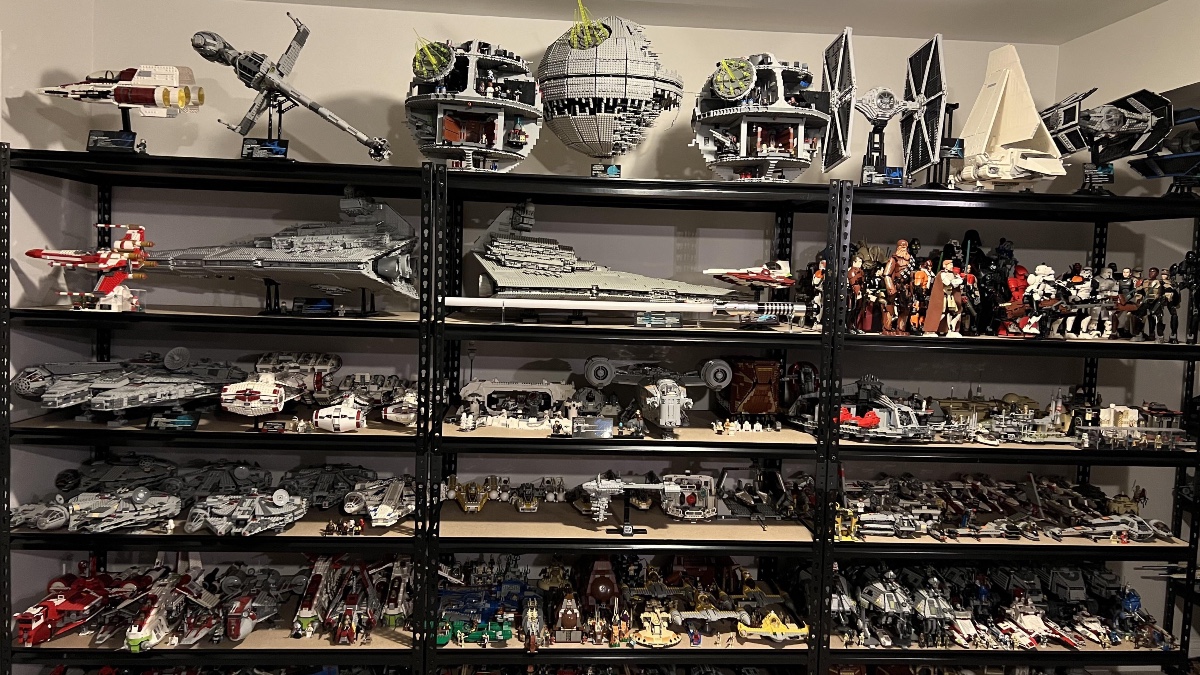
It starts with a $10 microfighter. Maybe it was a gift. Or maybe you just wanted something small for your desk to remind you of that one scene in A New Hope. Fast forward three years, and you’re looking at a $850 Millennium Falcon that takes up half your coffee table and requires its own insurance rider. That is the reality of building a Star Wars Lego collection. It isn't just a hobby. It’s a space-consuming, wallet-draining, oddly therapeutic obsession that has turned plastic bricks into a legitimate asset class.
The relationship between Lucasfilm and the LEGO Group is basically the "Gold Standard" of toy licensing. Since 1999, these two giants have released over 800 sets. Some are masterpieces of engineering. Others are just "grey slabs" that collectors complain about on Reddit for six months before buying anyway. But why do we do it? Is it nostalgia, or are we all just secretly hoping that 75192 UCS Millennium Falcon will pay for our kid's college tuition?
The Weird Economics of Plastic Bricks
Most people think of toys as depreciating assets. You buy a car, it loses value the moment you drive it off the lot. You buy a LEGO set, and sometimes, the value doubles the second the "Retired Product" tag hits the LEGO website. This is what enthusiasts call the "Aftermarket Boom."
Look at the Ultimate Collector Series (UCS). These are the big boys. They are designed for adults with disposable income and a lot of shelf space. When the original UCS Millennium Falcon (set 10179) came out in 2007, it retailed for $500. Today, a sealed one can easily fetch $3,000 to $5,000 depending on the box condition. That’s a better return than most index funds. But it’s not all sunshine and profit margins.
Investing in a Star Wars Lego collection is risky because LEGO loves a remake. If you spent $2,000 on a secondary market Cloud City set because of the rare Boba Fett minifigure with arm printing, you'd be sweating if LEGO suddenly announced a new, better version for $300. It happened with the UCS Death Star. It happened with the Snowspeeder. It’ll happen again.
The Minifigure Gold Mine
Sometimes the bricks don't even matter. Honestly, the real money is in the tiny plastic people. A Star Wars Lego collection is often valued more by its "Minifig count" than its piece count.
Take the 2003 Cloud City Boba Fett. He’s got printing on his arms and legs—a rarity back then. He can sell for over $2,000 on his own. Then there’s the solid bronze C-3PO or the white-gold Boba Fett (only two were ever made). These are the "White Whales." Most of us will never see them in person, let alone own them. But even "common" figures like Phase 2 Captain Rex have skyrocketed in value because LEGO went years without putting him in a cheap set.
What Most People Get Wrong About Collecting
There’s this massive misconception that you have to keep everything "New in Box" (NIB). If you’re purely an investor, sure, keep the tape sealed. But you’re missing the point. LEGO is a tactile medium. Part of the joy of a Star Wars Lego collection is the "greebling"—that’s the technical term for adding small, intricate details to a build to make it look complex and mechanical.
You haven't lived until you've spent six hours clicking 7,541 pieces together. Your fingers will hurt. Your back will ache. You will realize you missed a crucial structural brick on step 42 and have to tear the whole thing down. It’s brutal. It’s also incredibly rewarding.
Dust: The Silent Killer
If you display your sets, you have one enemy: dust. It gets into the studs. It cakes onto the wings of your X-Wings. If you don't stay on top of it, your beautiful Star Destroyer will look like it’s been sitting in a Tatooine junk shop for thirty years. Professional collectors use makeup brushes or compressed air. Some go full "museum mode" with custom acrylic cases from companies like Wicked Brick. If you're serious about your Star Wars Lego collection, expect to spend at least 15% of your total budget just on display solutions and cleaning supplies.
The "Grey Glue" Problem and the Prequel Renaissance
For a long time, the LEGO Star Wars line was criticized for being a "sea of grey." Imperial ships are, well, grey. Rebels have a bit of orange and red, but mostly, it’s grey. It can get repetitive.
However, we’ve seen a massive shift lately. The Prequel Trilogy fans have grown up. They have jobs now. They want Clone Troopers. The "Clone Wars" sub-theme has completely revitalized the hobby. We’re seeing more color—purples from Mace Windu’s legion, yellow from the Naboo Starfighters, and the deep reds of the Coruscant Guard. This variety is what keeps a Star Wars Lego collection from looking like a pile of scrap metal on your shelf.
The UCS vs. MBS Debate
LEGO recently introduced the Master Builder Series (MBS). While UCS sets are meant to be looked at, MBS sets are meant to be played with. The Mos Eisley Cantina (75290) is the perfect example. It’s huge, but it opens up. It has a bar. It has Greedo. It has a Dewback.
If you're just starting out, decide early: are you a "model builder" or a "diorama builder"? Model builders want the 3-foot-long Imperial Star Destroyer. Diorama builders want the scenes—the trash compactor, the throne room duel, the Dagobah hut. Mixing them can make a collection feel cluttered rather than curated.
How to Actually Build a Collection Without Going Broke
You don't need to buy every set. In fact, you shouldn't. LEGO releases dozens of Star Wars sets a year. If you try to catch them all, you’ll run out of room and money by June.
- Pick a Theme. Maybe you only collect "ships from the Original Trilogy." Maybe you’re a "Mandalorian" nut. Narrowing your focus makes your Star Wars Lego collection look intentional.
- Watch the Retirement Windows. LEGO sets usually have a shelf life of 18 to 24 months. Once they retire, prices on eBay and BrickLink go up. Use sites like Brickset to track when a set is "retiring soon." Buy it at retail price while you can.
- The BrickLink Method. If you want a specific ship but don't care about the minifigures, buy it "used" on BrickLink without the figures. You can often save 30-50% off the price.
- Facebook Marketplace is a Gold Mine. Parents often sell their kids' "buckets of LEGO" when they go to college. You can find rare 2000-era sets buried in those bins for pennies on the dollar. It takes cleaning and sorting, but the hunt is half the fun.
The Dark Side of Collecting: Brittle Brown and Yellowing
We have to talk about the quality issues. It’s not all perfect. If you’re buying older sets for your Star Wars Lego collection, be extremely careful with "Brittle Brown" and "Dark Red" pieces. Between 2012 and 2018, the chemical composition of these colors was slightly off. If you try to take a 2013 Sandcrawler apart, the brown plates might literally shatter in your hands like glass.
Then there’s sunlight. UV rays are the enemy of white and light grey bricks. If you leave your UCS Republic Gunship near a window, the side facing the sun will turn a sickly yellow within a year. Keep your collection in a climate-controlled room away from direct sunlight. This isn't just "toy talk"—this is preservation of an investment.
Practical Next Steps for the Aspiring Collector
If you're ready to dive in, don't just go to the store and grab the biggest box. Start with a plan.
First, download an app like BrickEconomy. It’ll help you track what you own and tell you the current market value of your sets. It's a great way to justify the hobby to a skeptical spouse when you can show them your "plastic" has appreciated 12%.
Second, join a community. The LEGO Star Wars subreddit or Eurobricks forums are full of people who have made every mistake you’re about to make. They know which sets are "flimsy" (looking at you, certain versions of the General Grievous Starfighter) and which ones are "rock solid."
Finally, check your local listings for "Bulk Lots." Buying a 20lb bag of unsorted LEGO might seem crazy, but finding a dusty, half-built TIE Interceptor at the bottom of that bag is a feeling no retail purchase can match. Organize your parts by type, not color. It’s the first rule of serious building. Get some plastic drawers, start sorting, and enjoy the click.