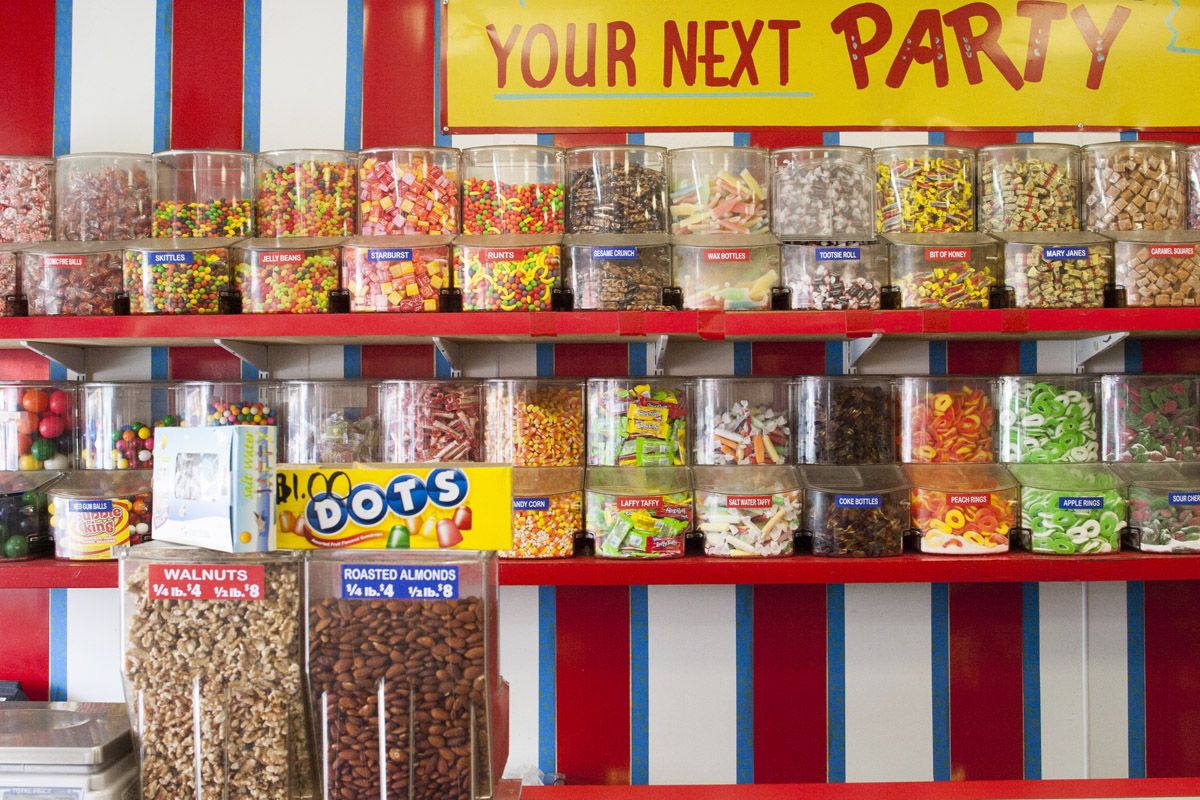
Step off the Q train at Stillwell Avenue and the salt air hits you first. Then, if the wind is blowing just right, you get the sugar. It is a thick, heavy scent that smells like childhood and burnt corn syrup. You follow that smell past the Nathan’s Famous lines, past the rattling tracks of the Cyclone, and you end up at a tiny, bright red storefront that looks like it hasn't changed since the 1940s. That’s Williams Candy Coney Island. It’s basically a time capsule with a cash register.
People come to Coney Island for the high-octane thrills, but they stay for the nostalgia. While the neighborhood around it undergoes massive gentrification and high-rise developments sprout up like weeds, Williams Candy remains a stubborn, delicious holdout. It’s been sitting at 1318 Surf Avenue for over 75 years. Honestly, in a city where businesses disappear overnight because of a rent hike or a change in trends, the survival of this candy shop is a minor miracle.
It isn't fancy. There are no artisanal, small-batch, sea-salt-infused truffles here. You won't find a "flavor profile" or a sommelier. You get sugar. You get nuts. You get a stick through a piece of fruit. And somehow, that is exactly what everyone wants.
The Sticky Physics of the Perfect Candy Apple
When you talk about Williams Candy Coney Island, you have to start with the apples. They are the undisputed kings of the display window. You've probably seen them: rows of bright, neon-red globes reflecting the boardwalk sun. But there is a real craft to this that people overlook.
The shop uses a specific type of apple—usually a crisp, tart variety like a Granny Smith or a McIntosh—because you need that acidic snap to cut through the overwhelming sweetness of the coating. If the apple is too soft, the whole thing turns into a mealy mess. If the candy isn't heated to exactly the right temperature, it’ll either be too sticky to eat or so hard it’ll chip a tooth. The folks behind the counter at Williams have mastered the "hard crack" stage of sugar boiling.
They don't just do the classic red ones, though. You’ve got the caramel apples, often rolled in crushed peanuts or sprinkles. Then there are the "jelly" apples. If you aren't from New York, you might not know the difference. A candy apple is hard and glass-like; a jelly apple is softer, almost chewy, with a bright red coating that sticks to your teeth in the best way possible. It’s a texture thing. Some people swear by the crunch, others want that gummy, fruit-flavored exterior.
Beyond the Fruit: Popcorn, Marshmallows, and Nostalgia
It’s easy to get distracted by the apples, but the shop is actually a treasure trove of "old-school" treats. Look at the popcorn. They make it right there. It isn't that yellow, butter-flavored dust you get at the movie theater. This is heavy, thick caramel corn or classic salty kernels.
One of the most underrated items at Williams Candy Coney Island is the marshmallow stick. It’s a simple concept: three or four large marshmallows on a wooden skewer, dipped in caramel, and then rolled in toasted shredded coconut or nuts. It sounds basic because it is. But when you’re walking down the boardwalk in the breeze, it’s the perfect portable snack.
- Pistachio Ice Cream: They serve it. It’s bright green, very creamy, and tastes like 1955.
- Cotton Candy: Spun fresh. It’s basically a pink cloud on a stick.
- Fudge: Dense, heavy, and sold in blocks that could double as doorstops.
The interior of the shop is cramped. It's narrow. If more than five people are inside, you’re bumping elbows. The walls are lined with photos of celebrities who have visited over the decades, and the counters are piled high with pre-packaged nostalgic candies—the kind of stuff you can’t find at a CVS. We’re talking about wax lips, candy buttons on paper strips, and those little flying saucer wafers filled with beads of sugar.
Why the Location at 1318 Surf Avenue is Iconic
Geography is everything in New York. Williams Candy sits right next to Nathan’s Famous. This is the power alley of Coney Island. You eat a couple of hot dogs, you feel that salt craving kick in, and you naturally drift three doors down to get something sweet. It’s a symbiotic relationship that has fueled the local economy for generations.
The shop survived the decline of Coney Island in the 70s and 80s. It survived Hurricane Sandy, which flooded much of the area. It even survived the COVID-19 lockdowns that shuttered so many other historic New York spots. Why? Because it’s affordable. In a city where a cupcake can cost seven dollars, you can still get a treat at Williams for a few bucks. It remains one of the few places where a working-class family can take their kids and not feel like they're being squeezed for every cent.
The Reality of Running a Legacy Business
Let’s be real for a second: running a place like this is grueling. It isn't just "handing out candy." The heat from the sugar kettles makes the shop incredibly hot in the summer—exactly when the crowds are at their peak. The staff is constantly moving, dipping apples, bagging popcorn, and dealing with thousands of tourists who all want to take a picture of the window display without necessarily buying anything.
There’s a grit to it. The floor is usually a bit sticky. The service is fast and "Brooklyn-direct." Don't expect a long, lingering conversation if there’s a line behind you. They want to know your order, get your cash, and move on to the next person. It’s part of the charm. It’s authentic.
Common Misconceptions About Williams Candy
A lot of people think these shops are just for tourists. That’s not true. If you go there on a Tuesday in October, you’ll see locals from Brighton Beach and Gravesend stopping in. It’s a community staple. Another misconception is that the candy is "too sweet." Well, yeah. It’s a candy store. But the balance of the tart apple or the salty nuts is what makes it work.
Some people also assume the shop is part of the larger Luna Park or Deno’s Wonder Wheel Park. It isn't. It’s an independent family-owned business. That distinction matters because it means their survival depends entirely on the quality of that next batch of fudge or that next tray of jelly apples.
How to Do Williams Candy Like a Pro
If you’re planning a trip, don’t just walk in and grab the first thing you see. Check the "freshness" cues. The best time to go is mid-afternoon when they are actively replenishing the window displays.
- Bring Cash: They do take cards now, but in a place this old-school, cash just makes the line move faster. Plus, it feels more right.
- The Napkin Rule: Take three times as many napkins as you think you need. A candy apple is a structural disaster waiting to happen once you start biting into it.
- The "Take Home" Strategy: Get a candy apple for the walk, but grab a bag of the caramel corn for the train ride home. The caramel corn holds up surprisingly well and doesn't get soggy.
- Check the Season: While they are open year-round, the vibe changes. In the winter, it’s quiet and cozy. In the summer, it’s chaotic and electric. Both have their merits.
The Future of Coney Island's Sweetest Corner
There is always talk about "modernizing" Surf Avenue. Developers want more glass, more steel, and more high-end retail. But spots like Williams Candy Coney Island provide the "soul" that these developers are trying to monetize. You can’t manufacture 75 years of sugar-crusted history.
When you stand in front of that window, looking at the reflection of the Cyclone in the red candy coating of an apple, you’re seeing a version of New York that is rapidly disappearing. It’s a reminder that sometimes, the simplest things—sugar, fruit, and a wooden stick—are the ones that last the longest.
Next time you find yourself at the end of the subway line, skip the fancy artisanal dessert spots in North Brooklyn for a day. Head south. Look for the red sign. Get the apple. It’s worth the sticky fingers.
What to do next:
- Plan your visit: The shop is located at 1318 Surf Ave, Brooklyn, NY 11224. It’s literally steps from the Stillwell Ave Station (D, F, N, Q trains).
- Check the weather: If it’s an exceptionally humid day, the hard candy on the apples can get a bit "weepy." For the best "snap," go on a clear, dry day.
- Explore the block: After getting your candy, walk toward the boardwalk and visit the Coney Island Museum to see the history of the side-show culture that grew up right alongside this shop.