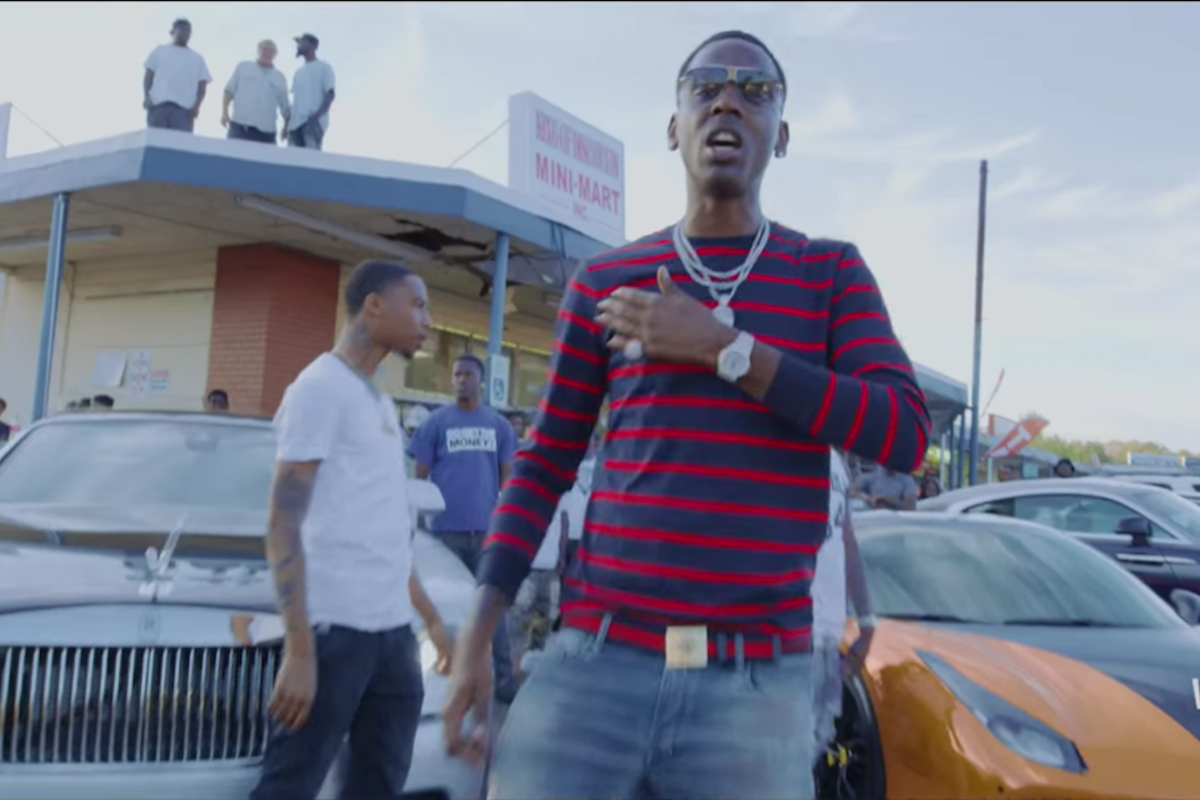
It was February 2017. Charlotte was buzzing because of the CIAA tournament weekend. But the real story wasn't on the court. It was on the pavement of 2nd Street. That’s where Young Dolph 100 shots became more than just a headline; it became a piece of hip-hop folklore that redefined the "bulletproof" persona of Adolph Thornton Jr.
People still talk about it. How do you walk away from that? Seriously. Imagine sitting in a custom-painted, multi-million dollar SUV and suddenly the world turns into a hail of lead. We aren't talking about a couple of stray rounds from a drive-by. We are talking about a sustained, military-grade ambush.
What Actually Happened During the Charlotte Ambush?
The math is terrifying. Police later recovered about a hundred shell casings from the scene. It wasn't just a targeted hit; it was an execution attempt on a massive scale. Dolph was headed to a performance at Cameo Charlotte. He was riding in his black SUV, a vehicle that he’d famously spent roughly $300,000 to $600,000 armor-plating.
That investment saved his life.
The gunmen pulled up and let loose. Bystanders hit the deck. Nearby apartment buildings were riddled with holes. It felt like a movie set, but the blood and the smell of sulfur were real. Dolph didn't just survive; he basically shrugged it off. He performed that night. He didn't hide in a hotel room or fly back to Memphis immediately. He stepped on stage and let the crowd know he was still the "King of Memphis."
Honestly, the sheer audacity of it is what cemented his status. Most rappers talk about being "outside," but Dolph proved he was built differently. He didn't play the victim. Instead, he used the moment to fuel his marketing.
The Bulletproof Logistics
People wonder how a car holds up against that much fire. It isn't just "thick glass." High-level armoring involves ballistic steel plates behind the door panels, run-flat tires, and reinforced pillars. When you hear about Young Dolph 100 shots, you have to realize that if he had been in a standard factory Escalade, the story of Paper Route Illuminati would have ended seven years earlier than it did.
He knew the risks. Being an independent powerhouse in a city with deep-rooted gang rivalries and complex industry politics meant he was always moving with a target on his back. Memphis is a beautiful city, but it's "ten toes down" for a reason.
Turning Trauma Into "100 Shots" the Song
Music is how Dolph processed the chaos. He didn't go to therapy in the traditional sense; he went to the booth. The track "100 Shots" off the Bulletproof album is perhaps one of the most defiant records in the history of trap music.
The beat, produced by DJ Squeeky, has this ominous, heavy-hitting bass that feels like a heartbeat in a dark alley. Dolph starts the track by mocking the shooters. He asks how you miss a hundred times. It’s cold. It’s calculated. It’s purely Dolph.
- "A hundred shots, a hundred shots / How the f*** you miss a whole hundred shots?"
- He mentions his $300,000 armor job.
- He calls out the "industry" and the fake love.
The album itself was a masterpiece of pettiness and business savvy. Look at the tracklist. If you read the song titles in order, they tell a story: "100 Shots," "In Charlotte," "But I’m Safe," "That’s How I Feel," "I’m So Real," "I Pray For My Enemies," "I’m Everything You Wanna Be," "So Stressful," "Sunshine," and "I Got The Bag."
He literally spelled out his survival and his dominance through the track sequence. That is marketing genius you just don't see from "standard" artists. He took a traumatic event that would have sidelined most people and turned it into a multi-million dollar brand moment.
The Blac Youngsta Connection and the Legal Fallout
You can't talk about Young Dolph 100 shots without mentioning the fallout with Blac Youngsta and Yo Gotti’s CMG camp. The rivalry was thick. It was tense. In May 2017, Blac Youngsta (born Sammie Benson) and two other men turned themselves in to Charlotte authorities. They were facing felony charges related to the shooting.
The charges were eventually dropped in 2019. The DA cited a lack of evidence to prove beyond a reasonable doubt who actually pulled the triggers. It’s a recurring theme in these types of cases—the "street code" often keeps witnesses silent, and forensic evidence in a chaotic 100-round shootout is notoriously messy.
Dolph never publicly pointed fingers in a legal sense. He kept it in the music. He understood that the streets handle things differently, and for him, winning meant getting richer and staying independent.
Why Memphis Politics Mattered
Memphis rap isn't like New York or LA. It’s smaller, more concentrated, and deeply personal. Dolph’s rise as an independent artist under his own label, Paper Route Empire (PRE), rubbed people the wrong way because he refused to sign with the established local giants.
He was a disruptor. When you disrupt a local economy, especially one tied to the music industry and the influence that comes with it, things get violent. The 100 shots in Charlotte were a physical manifestation of a business dispute that had spiraled out of control.
The Long-Term Impact on Hip-Hop Culture
The Charlotte incident changed the way rappers think about security. Before Dolph, having an armored car was something for heads of state or drug kingpins. After Dolph, it became a standard business expense for high-profile artists.
We saw it with others later on. The realization that you could be "untouchable" if you spent the money on the right tech changed the game. But it also heightened the stakes. If the target is armored, the attackers just bring more heat or wait for a moment when the target is vulnerable.
The Tragedy of Makeda’s Cookies
It’s impossible to look back at the survival of 100 shots without the crushing weight of what happened later. In November 2021, Dolph was killed at Makeda’s Homemade Butter Cookies in Memphis. He wasn't in the armored car. He was just picking up cookies for his mother.
It’s a stark reminder. You can survive a hundred rounds from a high-powered rifle in a Charlotte ambush, but the dangers of home are often the hardest to navigate. The irony isn't lost on fans. The man who survived the "impossible" was eventually taken down in a routine moment of everyday life.
Realities of the Investigation and Evidence
The Charlotte-Mecklenburg Police Department had a nightmare on their hands. Processing a scene with 100 casings involves mapping every trajectory. They found that bullets hit a nearby Hyatt and several other vehicles.
- The Van: Investigators focused on a rented van used by the shooters.
- The Weapons: Rifles and handguns were used, indicating multiple shooters with different roles.
- The Armor: Dolph’s SUV was a Level B6 or B7 protection grade, capable of stopping high-velocity rifle rounds like those from an AK-47 or AR-15.
Most people don't realize how heavy those cars are. An armored SUV can weigh double its original weight. You have to upgrade the brakes, the suspension, and the engine just to make it drivable. Dolph wasn't just "lucky." He was prepared.
Lessons from the Dolph Era
Young Dolph’s legacy isn't just about surviving a shooting. It’s about the mindset of "Paper Route." He taught a generation of artists that you don't need a major label to be a superstar. You need a vision, a hustle, and the willingness to protect what you built.
The Young Dolph 100 shots story is a testament to his foresight. He knew the world he lived in. He didn't complain about the dangers; he mitigated them.
Actionable Takeaways for Understanding the Incident
If you are looking at this from a fan's perspective or an aspiring artist's view, there are real things to learn here about the intersection of street life and the music business.
- Invest in Yourself: Dolph spent six figures on a car because his life was worth more than his bank account. In any business, protecting your primary asset (you) is the first priority.
- Control the Narrative: Instead of letting the media paint him as a victim of "gang violence," Dolph framed himself as an invincible hero. He turned a near-death experience into a marketing campaign for his best-selling album.
- Understand the Risks of Independence: When you go "independent," you are often cutting out the "middlemen" who provide certain types of protection—both legal and social. You have to be ready to stand on your own.
- The Importance of Local Roots: Dolph’s commitment to Memphis was his greatest strength and his greatest vulnerability. Staying connected to the community provides authenticity, but it also keeps you in the line of fire.
The Charlotte shooting remains one of the most brazen attacks in modern music history. It didn't have the "mystery" of the Tupac or Biggie shootings because it happened in the era of social media and high-definition forensics, yet it still carries that same weight of "what if."
Dolph’s ability to walk away from that scene, get on a stage, and perform "Play Wit Yo Bitch" is peak hip-hop defiance. It’s a moment that will be studied as long as trap music exists. He didn't just survive 100 shots; he made them irrelevant.
To truly understand the impact, you have to listen to the Bulletproof album from start to finish. It’s not just music. It’s a document of a man who refused to blink when death was staring him in the face through a windshield on a Saturday night in North Carolina.
Stay focused on the business, keep your circle tight, and always make sure your "car" is ready for whatever the world throws at it.
Next Steps for Deep Research:
- Review the Charlotte-Mecklenburg Police Department's public statements from 2017 regarding the 2nd Street incident to see the ballistic reports.
- Analyze the lyrics of the Bulletproof album to see how Dolph meticulously deconstructed the event across ten tracks.
- Study the court documents from the 2019 dismissal of charges against the accused to understand the complexities of prosecuting high-profile "street" cases.