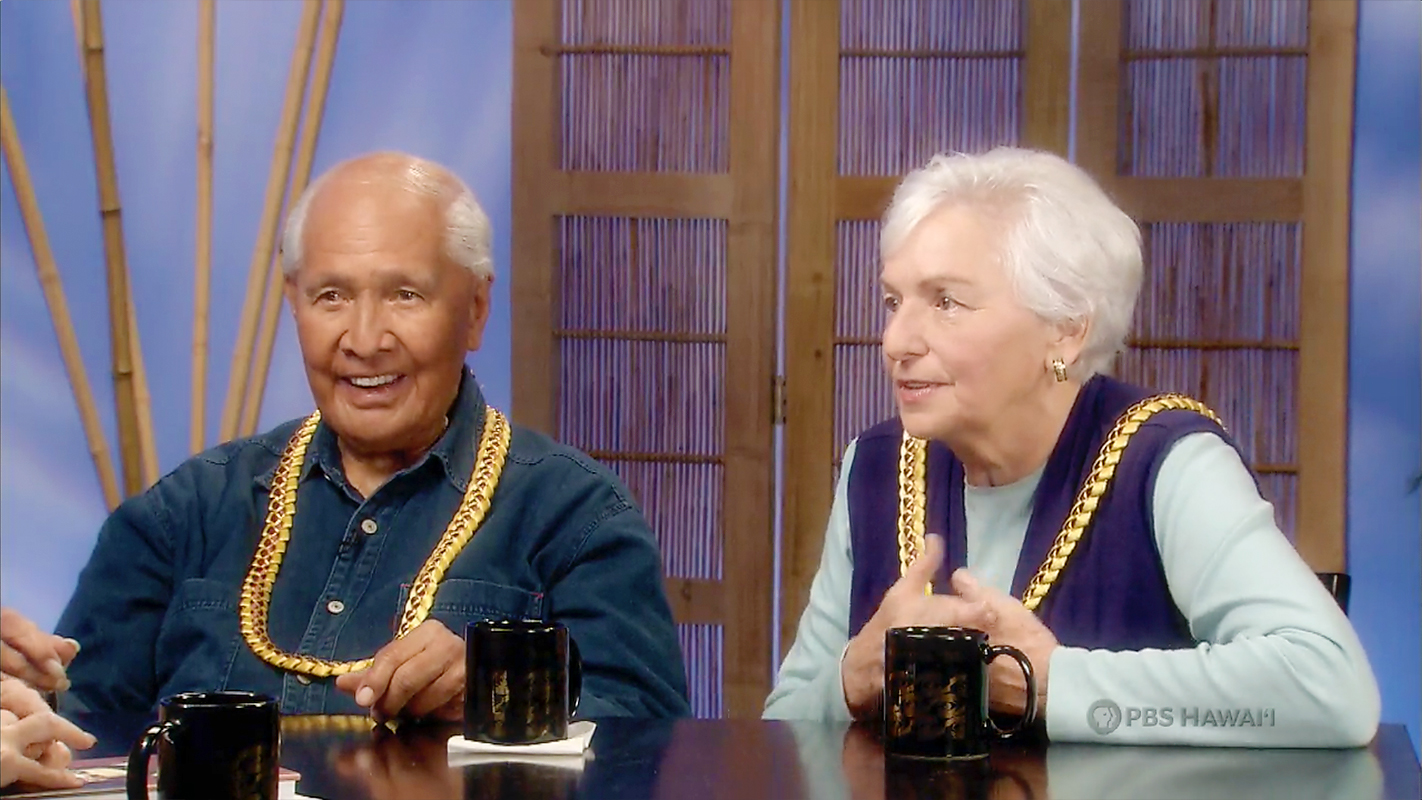
When people talk about the "Hawaiian Renaissance," they usually start with the music. They mention the Sons of Hawaii or the resurgence of the slack-key guitar. But if you look behind the curtain of that movement, you find a relationship that was essentially the engine room for the entire thing. In a very literal sense, the moment Eddie Kamae married Myrna 1962, the trajectory of Hawaiian history shifted. It wasn't just a wedding; it was the birth of a production powerhouse that would eventually document a dying way of life before it vanished for good.
Myrna was a flight attendant for Hawaiian Airlines when they met. Eddie was already a legend on the 'ukulele, though he was arguably at a crossroads. He had spent years mastering Latin and jazz styles—basically playing everything except traditional Hawaiian music.
Why 1962 Was the Turning Point
Marriage changes people. For Eddie, it seemed to ground him in a way that his solo wandering never did. Honestly, without Myrna’s organizational backbone, Eddie might have remained a brilliant but directionless virtuoso. She became his researcher, his producer, and his sounding board.
They got hitched during a time when Hawaii was rapidly changing. Statehood was fresh. Tourism was exploding. The "authentic" Hawaii was being paved over by high-rises in Waikiki. By the time Eddie Kamae married Myrna 1962, the couple realized that the kupuna (elders) who held the songs and stories of the old islands were passing away.
It's kinda wild to think about now, but Eddie wasn't always a filmmaker. He was a musician who realized the music wasn't enough. He needed to capture the faces, the voices, and the specific wind names of the valleys. Myrna was the one who helped him transition from the stage to the editing room. She managed the Hawaiian Legacy Foundation. She did the paperwork. She made sure the stories of places like Lahaina or the Waipiʻo Valley didn't just become footnotes in a textbook.
The Dynamics of the Kamae Partnership
Most celebrity marriages in the 60s were about public appearances. This was different. Myrna was deeply involved in the "The Hawaiian Legacy Series." This wasn't a hobby. It was an obsessive, decades-long project to film the last living links to pre-territorial Hawaii.
Think about the sheer logistics.
You've got a musician who wants to travel to remote corners of the islands to talk to elderly farmers and singers. You need equipment. You need funding. You need a way to archive thousands of hours of footage. Myrna was the strategist. While Eddie was the soul of the operation, she was the structure. People who knew them often said they functioned as a single unit. It’s hard to find a photo of one from that era without the other nearby, usually working on a script or a sequence.
Beyond the Music: A Shared Mission
If you've ever seen Listen to the Forest or The Hawaiian Way, you're seeing the fruit of a 1962 pact. They weren't just making movies; they were creating a library.
Eddie often credited his "second life" in music—his return to his roots—to the stability and encouragement he found at home. Before the marriage, he was known as the guy who could play "Malaguena" on a four-string 'ukulele faster than anyone on earth. After, he became the man who sat at the feet of Sam Li'a and learned what it actually meant to be Hawaiian.
There's a specific nuance to their work that often gets missed. They didn't just document the famous stuff. They went for the obscure. They looked for the "hidden" songs. Myrna’s role in researching these lineages was massive. She wasn't just a "supportive spouse." She was a co-curator of the culture.
Dealing With the Modern Lens
Looking back from 2026, it's easy to romanticize the 60s. But for a Hawaiian couple trying to preserve indigenous culture in 1962, it was an uphill battle. The "Renaissance" hadn't happened yet. Speaking Hawaiian was still discouraged in many circles. The Kamaes were working in a vacuum.
When Eddie Kamae married Myrna 1962, they weren't joining a movement; they were starting one. They had to convince people that these stories were worth saving. It took guts. It took Myrna’s business sense to keep the Foundation afloat when nobody cared about documentaries.
What We Can Learn From the Kamae Legacy
The biggest takeaway from their life together isn't just the films. It’s the model of "collaborative preservation."
One person has the vision; the other provides the path. Eddie had the mana (power/spirit), and Myrna provided the vessel. They stayed married until Eddie’s passing in 2017. That’s over 50 years of continuous cultural production. You don't see that kind of longevity in the arts much anymore.
Their work proved that documentation is a form of activism. By filming the kupuna, they ensured that a child born in Honolulu today can hear the exact inflection of a voice from 1890. That doesn't happen by accident. It happens because two people decided in 1962 to tie their lives together and focus on something bigger than themselves.
Practical Steps for Engaging with the Kamae Heritage
If you want to actually understand what this partnership produced, don't just read about it. The material is out there.
- Watch "Those Who Came Before": This is perhaps the best entry point into their filmmaking style. It shows the reverence Eddie had for his teachers, a reverence fueled by the stability Myrna provided behind the scenes.
- Visit the Hawaiian Legacy Foundation: This is the organization Myrna helped lead. They have archived a staggering amount of material that goes way beyond the 'ukulele.
- Listen to the "Sons of Hawaii" albums from the mid-60s: Notice the shift in Eddie's playing. It moves from "showy" to "deep." That's the sound of a man who has found his purpose.
- Support Indigenous Archiving: The Kamaes showed that personal archives are often more valuable than state ones. If you have family stories, record them now. Don't wait for a "professional" to do it.
The story of the Kamaes isn't a "celebrity wedding" story. It's a story of a mission. When we look at the year 1962 in Hawaiian history, we see the start of a quiet revolution led by a man with a guitar and a woman with a plan. Their marriage was the foundation upon which the modern pride in Hawaiian identity was built. Without Myrna, Eddie Kamae would have been a great musician. With her, he became a pillar of a nation’s memory.